Dr. John Kee's article, "Snakes and Ecology in Byzantine Aesthetics," features in the new issue of Speculum
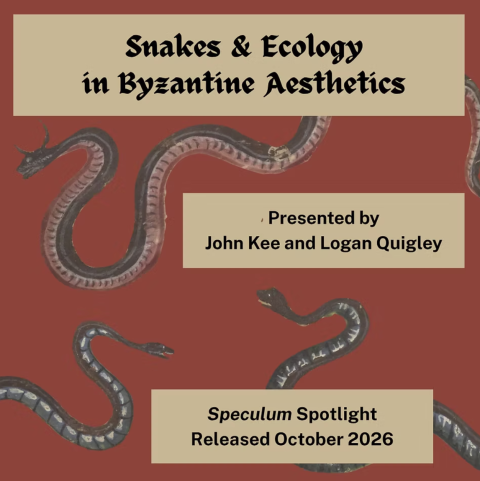
Dr. John Kee, our incoming postdoc, has just published a cutting-edge article, "Snakes and Ecology in Byzantine Aesthetics," in the latest issue of Speculum.
The article is available here, valid for 50 free viewings of an online PDF!
Besides, John also discusses his research on Speculum's podcast, which you can listen to here.
To whet your appetite, in the words of John Kee, "Anthropologists, evolutionary theorists, and others have asserted profound connectionsbetween snakes and human cognition and culture, yet these animals have not played a majorrole in ecological approaches to the Middle Ages. This essay engages such views in order tointegrate the possibility of deep, even evolutionary links to these creatures with the humanities’ traditional orientation toward cultural contingency and creativity. Via case studiesranging from Philo of Alexandria (first century CE) to Basil of Caesarea and John Chrysostom(fourth century) to the Paris Nicander (c. 1000), it argues that in Byzantium (broadly construed), snakes acted as figures of latent danger across a wide variety of contexts, providinga means for representing the environmental entanglement of perception in general. Theseanimals’ special salience for humans presents not a constraint on but an opportunity for cultural creativity, helping to make possible, without determining, new acts of literary or artisticproduction. Snakes can thus stand as exemplary figures of what might be called “ecologicalaesthetics”: evaluative sensory engagement with the environment from a perspective not ofdetached contemplation but active involvement."